

Humanitarian mission in Cambodia · AVEC Sentinelles
AVEC Sentinelles Charter
What we’ve learned in twenty years protecting vulnerable children. What you need to know before you get involved.
First of all
Why this charter exists
This charter isn’t an administrative rulebook. It’s what we’ve learned in twenty years working alongside vulnerable children, and what you need to know before you take the leap.
Read it without rushing. If a rule seems strange to you, it exists because of a true story. By the end, you’ll know whether you want to apply.
Principle 1
The long haul, not tourism
We don’t take on Sentinelles for less than three months. This isn’t a whim. The children you’ll be working alongside have lived through abandonment, broken ties and hurried departures. Every adult who appears in their life and then disappears three weeks later replays that trauma. Three months is the minimum needed to pass on something lasting. Six months is ideal.
For these reasons, you don’t enter Cambodia on a tourist visa. AVEC takes care of your professional visa and your work permit. You’re a volunteer, but a legal one.
Principle 2
Strict volunteering, and lunch under the mango tree
You fund your own flight, accommodation and daily life on site. No expenses covered. This is our guarantee of transparency to our donors: every franc raised goes to the children, not to the organisation.
In return, every day you’ll have lunch with the team under the mango tree. Hearty Khmer meals and easy conversation — this is also where you’ll learn the most about life in the field. Budget around 400 to 600 CHF a month for your day-to-day living costs on site, excluding accommodation, depending on your lifestyle.
Principle 3
Making yourself unnecessary
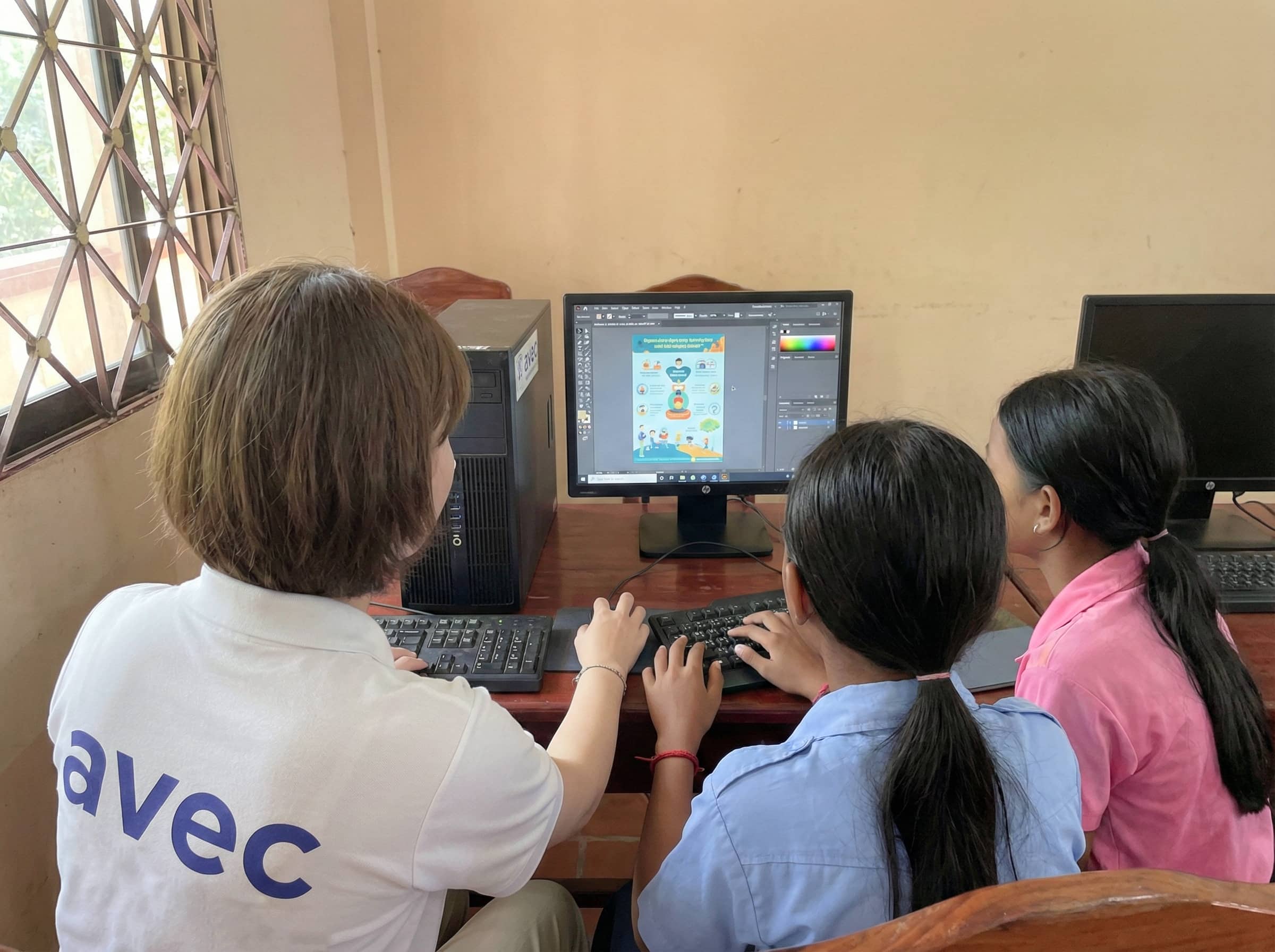
Our founding paradox: your mission is to train your Cambodian counterparts so that, by the end, they can manage without you. You’re not there to do the work in place of the local team — you’re there to pass on a method, a tool, a skill that will remain once you’ve gone.
In practice, you always work in pairs with a Khmer trainer or colleague. They handle the language, the authority, the relationship with the children. You bring the technical skill. It’s a genuine exchange, not a top-down handout.
Principle 4
What you won’t do
No emotional caregiving
You won’t cuddle the children, and you won’t play the role of a substitute parent. This emotional work is reserved for our Cambodian professionals, who are their stable attachment figures. This is our strictest rule, because it’s the one that protects them best.
No unapproved photos
You won’t photograph the children without approval from our child protection officer. Their image belongs to them, and we use it with the utmost care to preserve their dignity and safety.
No family on site
You won’t bring your family along to the mission site. The presence of expatriate children alongside our beneficiaries can reopen wounds that no one can control. This is a requirement of neutrality, not a judgement on family.
Principle 5
Who we’re looking for
Background: a Bachelor’s degree at minimum, or the equivalent through experience. A solid skill: fundraising, digital communication, tech, teaching, management, automation. The ability to deliver a concrete result with limited resources.
A mindset: you accept that you won’t understand everything straight away, you welcome the slow pace of the field, and you don’t try to impose a European model. You find beauty in quiet transmission.
A situation: you can fund your own presence, you don’t have young children depending on you during the mission, and you accept the pace of a tropical country and a close-knit team.
Principle 6
The selection process
You submit a pre-application in four minutes via our form. If your profile matches an open mission or a future need, we’ll get back to you within ten days.
For the next step, we’ll ask you for a CV, a cover letter, your qualifications, a criminal record check, and two professional references, which we systematically call. This vetting is rigorous as a matter of ethical duty. The children deserve that we take the time.
If everything fits, we’ll have a call. If moving forward makes sense for you as much as for us, you’ll sign the agreement and we’ll prepare your departure.
Sound like you? Four fields, three minutes.
A reply within ten days. It’s the first step.