
School sponsorship — no named child
Education as a safeguard against trafficking
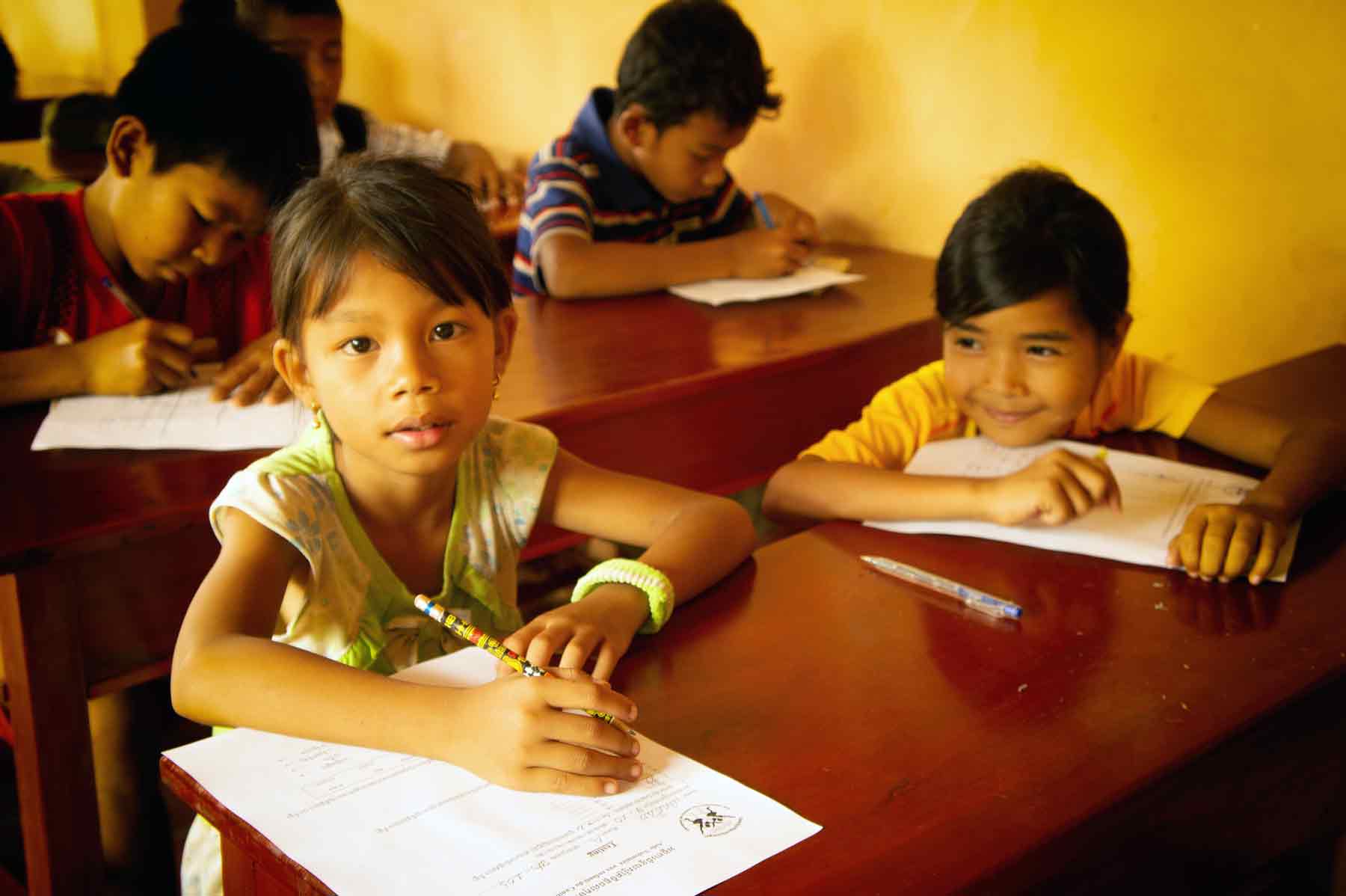
One hundred and fifty-six pupils supported in 2025 in Battambang’s state schools. No orphanage, no institutional placement. Just enough to stay in school when everything else pushes them to leave.
State school is free. In theory
In Cambodia, state school is officially free of registration fees. In practice, uniforms cost money, school supplies cost money, transport costs money, informal parental contributions cost money. For the most vulnerable families, these accumulated costs put school out of reach. School drop-out is widespread, particularly among girls, particularly at the start of secondary school.
And behind the drop-out, there is often something else. A child who leaves school at ten or twelve becomes a target. For informal textile factories, for building sites, for trafficking networks. Keeping a child in school is not just an educational investment. It is a measure of physical protection.
How AVEC supports these schools
Our approach is not to fund each child individually, but to support a network of partner schools in Battambang province. Three main schools: Chrap Krasang, Sala Balat, Daksosor.
In 2025, the school supplies distributed to 156 schoolchildren cost 6 566 dollars, around 42 dollars per child. That figure does not tell the whole story: the time our teams put in, the visits to villages and the trips by motorbike, always in twos for safety, are added on top and shared with our other programmes.
Quarterly distributions
Four times a year, AVEC distributes supplies in the partner schools: exercise books, pens, uniforms, school bags, food for the most vulnerable families.
Support for families
One hundred families supported directly. Regular food supplies, social support. A child cannot study calmly if their family is hungry. That is the whole point.
Home visits
Between distributions, our teams visit the most vulnerable families. It is patient work on attitudes, so that education becomes a family priority, not an option.
The hard figures for 2025
156
Pupils supported
In the three partner schools in the province
2 886
Exercise books distributed
With 350 school bags and 322 uniform shirts
3 000 kg
Of rice distributed
1 800 bottles of sauce, food support for the 100 families
70 → 200
Our historic proof
From the very first year, in 2005, enrolment at Daksosor school rose from 70 to 200 pupils. Enrolments almost tripled.
Become a sponsor of the schooling programme
You fund the quarterly distributions, the family visits, the food support. You do not sponsor a named child. You sponsor the programme that keeps children in school.
35 CHF
per month
One child in school
70 CHF
per month
Family supported
120 CHF
per month
Whole class
You can stop at any time. Donation tax-deductible in Switzerland and France.
Frequently asked questions
Why support state schools rather than set up an AVEC school?
Because the point is not to replace the Cambodian state, it is to fill the gaps. State school already exists, it has teachers, it has buildings. What is missing is whatever stops vulnerable families sending their children there. Our role is to remove those obstacles, not to build a parallel system.
How do you make sure the support really reaches the children?
Distribution takes place on site, run by our field team, in the presence of head teachers, with a named list kept by the schools. Check visits by the Sentinelles. Annual audit of the accounts. Traceability is kept to a standard beyond the sector’s usual norms, because that is the only way to keep donors’ trust.
What happens for girls specifically?
Girls’ drop-out is widespread at the start of secondary school, around the age of twelve. That is the age when early marriage, domestic work or a move to a textile factory become options put forward by families. AVEC pays particular attention to this turning point, with strengthened family follow-up for the girls we identify as at risk.
Will I receive the first name and photo of a sponsored child?
No. These children are minors and vulnerable, they cannot consent to appearing in a fundraising campaign. You receive the programme’s quarterly newsletter, with group photos and anonymised testimonials. Our full ethics policy is explained here.